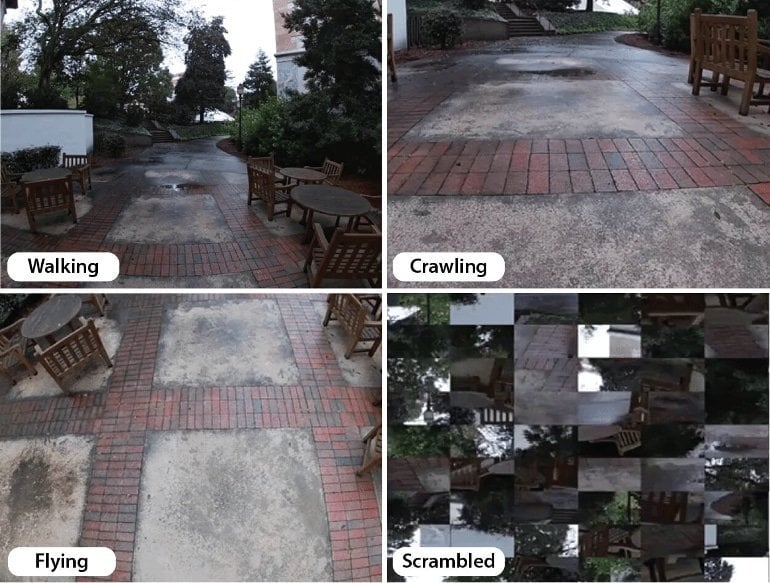
Visually Navigating on Foot Uses a Unique Brain Region

This shows different perspectives of a pathThe brain uses a specific region called the occipital place area (OPA) to navigate through spaces visually while walking, and not when crawling or using other modes of movement. This discovery sheds light on how children develop spatial awareness and interact with their surroundings as they learn to walk.

from Neuroscience News https://ift.tt/yQ8TsEr

Comments

Popular posts from this blog

UPI: Kids with psych disorders most likely to take dangerous viral challenges

The “choking game” — and other clearly ill-advised and dangerous internet challenges — leave many parents wondering what drives teens to take the bait and participate. Now, a new study suggests that an underlying psychological disorder may be one reason why some kids jump at online dares such as the “Bird Box” challenge, where people walk around blindfolded, and the Tide Pod challenge, daring people to eat laundry detergent. (January 28, 2019) Read the full article here from Brain Health Daily http://bit.ly/2DIWHbD

The emerging influential role of microglia in neurology

In her most catchily titled book, The Angel and the Assassin , Donna Jackson Nakazawa highlighed nerve cells which have hitherto been very little acknowledged – microglia . Long ignored as bit players in the big league of the nervous system, Nakazawa colourfully illustrated what many neuroscientists are beginning to realise: the small size of microglia belies their huge influence ; m icroglia are, after all, the defence force of the nervous system, protecting the brain from microbial invaders . In keeping with their small size, their role is to surreptitiously  present the antigens of invading bugs to T cells , the toffs who actually carry out the final hatchet job . It is therefore not surprising that any dysfunction of microglia will come with significant clinical consequences .  By GerryShaw – Own work , CC BY-SA 3.0 , Link The most important clinical fallout of dysfunctional microglia appears to be the emergence of dementia. It is indeed spec...

What are the pitfalls and perils of intracranial pressure?

Crudely speaking, the nervous system is made up of two parts. The peripheral nervous system , composed of nerves and muscles , is rather robust and roams free, exposed to the elements. On the other hand, the central nervous system , consisting of the brain and spinal cord , is delicate and fragile. It is therefore protectively cocooned in a rigid skull and a hardy vertebral skeleton . But even this tough fortress isn’t secure enough for these dainty neurones ; they are, after all, the command and control system for the whole body. Therefore, to further insulate them from the physical and physiological perturbations that continuously threaten them, nature has further sequestered them within a very exquisitely regulated irrigation system, the cerebrospinal fluid (CSF) . Internet Archive book Images on Flickr. https://www.flickr.com/photos/internetarchivebookimages/14769907251/ The CSF is actually a fine filtrate of the blood that flows in the arteries. The sieve is the very for...